
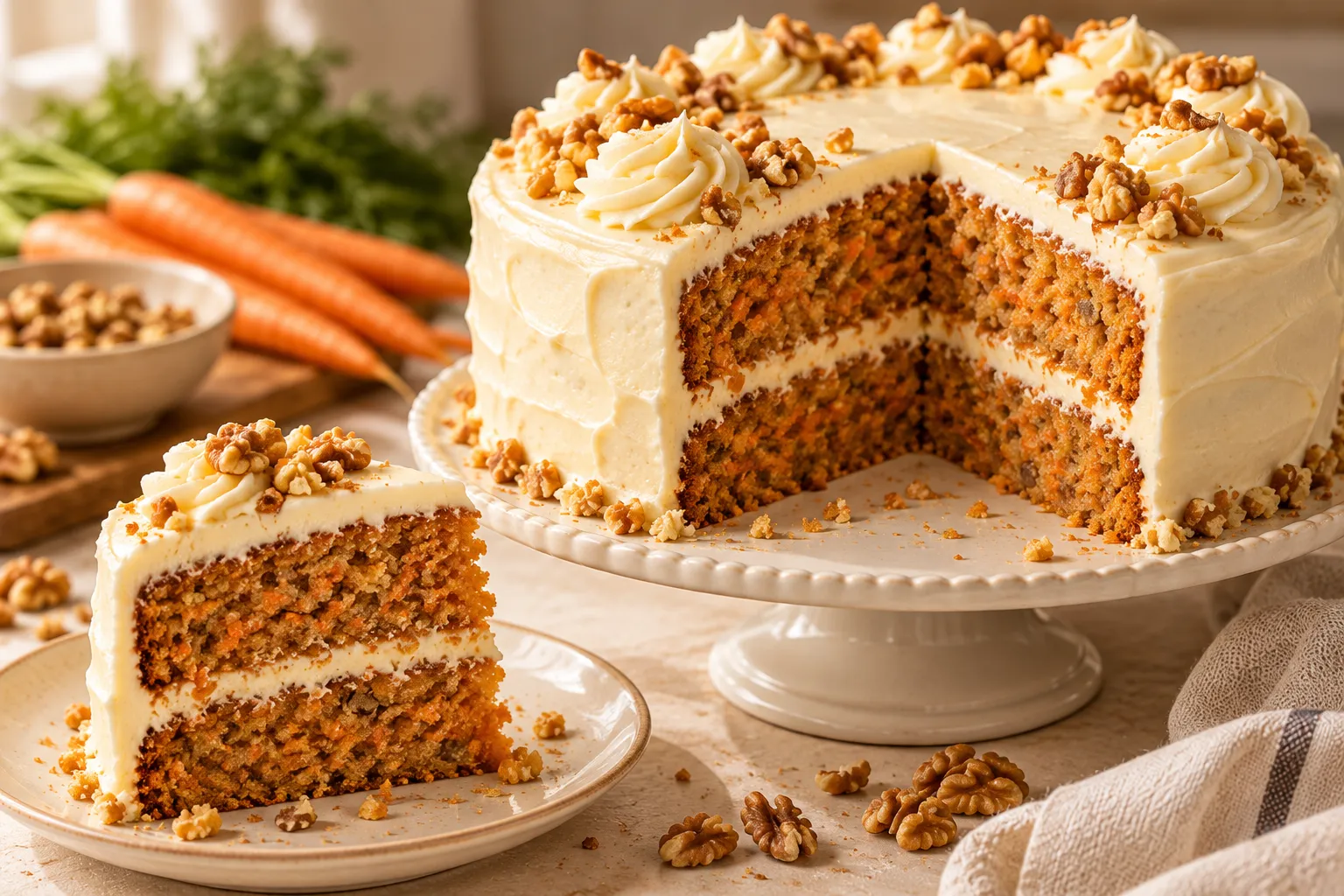
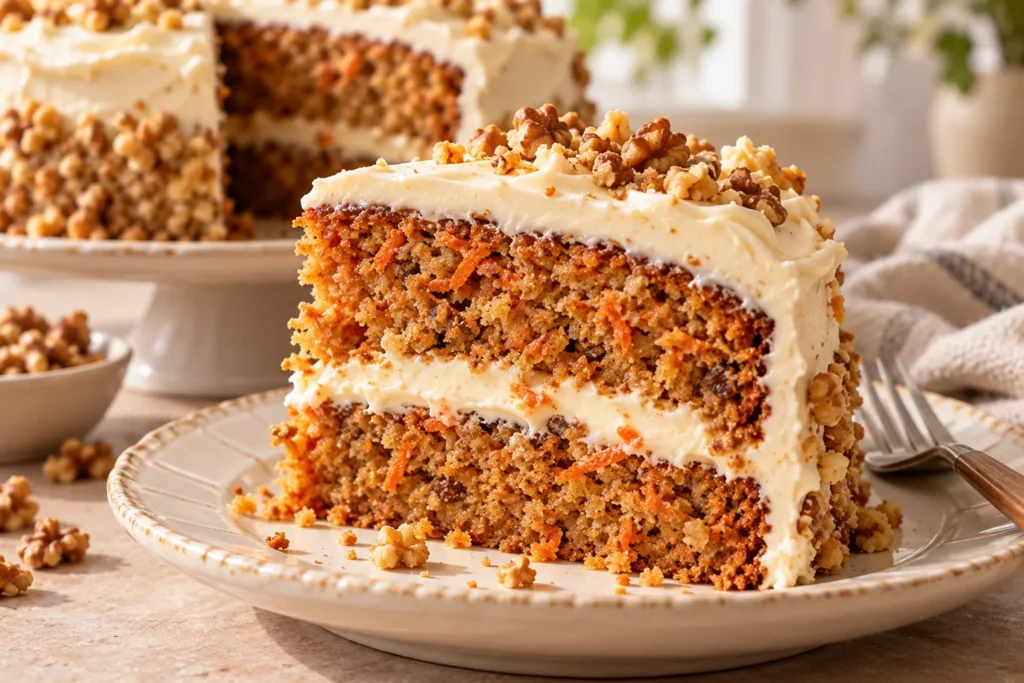
If you love the soft, moist texture of a bakery carrot cake, this homemade carrot cake recipe is one to keep. Made with freshly grated carrots, warm cinnamon, a touch of nutmeg, and a rich cream cheese frosting, it delivers everything you want in a classic carrot cake. Every slice is tender, flavorful, and topped with a smooth, tangy frosting that balances the cake’s natural sweetness.
The best part? You don’t need professional baking equipment or complicated techniques to make a cake that looks and tastes like it came from your favorite bakery. With a few simple ingredients and some helpful tips, you can create a beautiful homemade carrot cake for birthdays, holidays, family gatherings, or an everyday dessert.
Whether you serve it as a single-layer cake or turn it into an elegant two-layer celebration cake, this recipe is sure to become a favorite.
Why You’ll Love This Bakery-Style Carrot Cake
Moist and tender crumb: Freshly grated carrots, oil, and the right balance of ingredients help create a soft cake that stays moist for days.
Warm, comforting flavor: Cinnamon and nutmeg add a cozy spice flavor without overpowering the sweetness of the carrots.
Rich cream cheese frosting: The creamy frosting adds a slightly tangy flavor that pairs beautifully with the sweet, spiced cake.
Simple ingredients: You can make this recipe with everyday baking ingredients available at most grocery stores.
Perfect for special occasions: Its classic flavor and beautiful appearance make it suitable for birthdays, Easter, Thanksgiving, holidays, and dinner parties.
Easy to customize: Add chopped walnuts, pecans, raisins, or a little orange zest to create your preferred version.
Ingredients for Homemade Carrot Cake
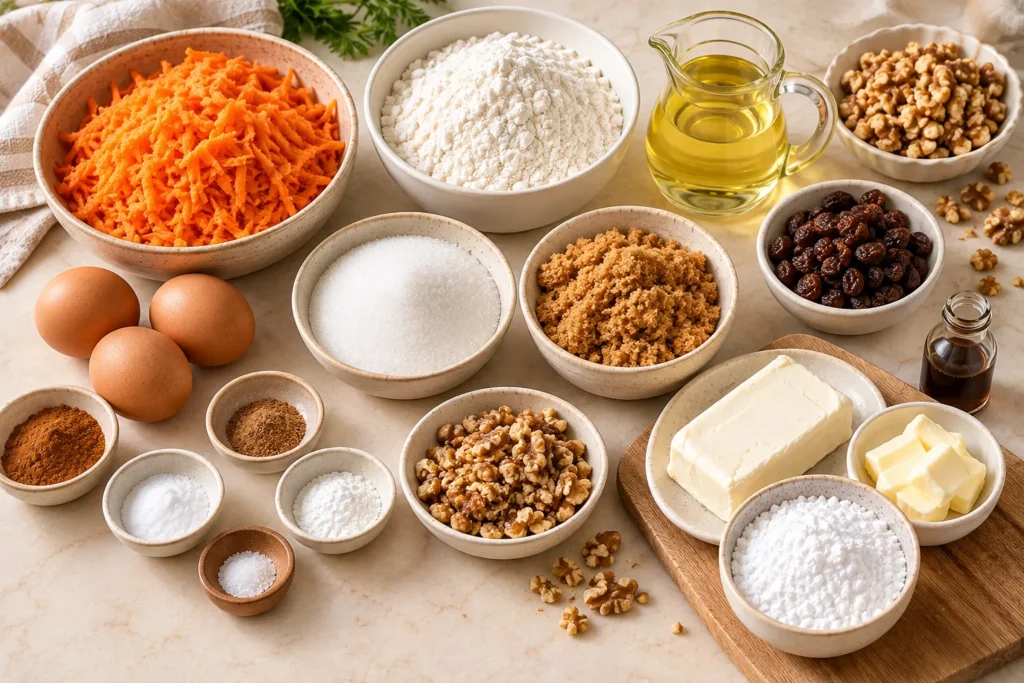
This recipe makes one 9-inch two-layer carrot cake, approximately 10–12 servings.
For the Carrot Cake
- 2 cups (250 g) all-purpose flour
- 1 teaspoon baking soda
- 1 teaspoon baking powder
- 1/2 teaspoon salt
- 2 teaspoons ground cinnamon
- 1/4 teaspoon ground nutmeg
- 3 large eggs, at room temperature
- 3/4 cup (150 g) granulated sugar
- 3/4 cup (165 g) packed light brown sugar
- 1 cup (240 ml) neutral vegetable oil
- 2 teaspoons vanilla extract
- 3 cups (approximately 300 g) finely grated carrots
- 3/4 cup (85 g) chopped walnuts or pecans, optional
- 1/2 cup (75 g) raisins, optional
For the Cream Cheese Frosting
- 8 oz (225 g) full-fat cream cheese, softened but still cool
- 1/2 cup (113 g) unsalted butter, softened
- 3 cups (360 g) powdered sugar, sifted
- 1 teaspoon vanilla extract
- A small pinch of salt
Ingredient Notes
Carrots: Freshly grated carrots are essential for the best texture. Finely grated carrots distribute evenly throughout the batter and help keep the cake moist. Avoid pre-shredded packaged carrots because they are often too dry and coarse.
Oil: Neutral vegetable oil, canola oil, or sunflower oil works well. Oil helps keep the cake tender even after refrigeration.
Brown sugar: Brown sugar adds moisture and a subtle caramel flavor. Combined with granulated sugar, it gives the cake a balanced sweetness and a bakery-style texture.
Spices: Cinnamon provides the main warm flavor, while a small amount of nutmeg adds depth. You can add a pinch of ground ginger if you enjoy a slightly more spiced cake.
Cream cheese: Use full-fat block cream cheese when possible. It generally produces a thicker, more stable frosting than cream cheese sold in a spreadable tub.
Nuts and raisins: These are optional. Walnuts provide a pleasant crunch, pecans add a buttery flavor, and raisins bring little pockets of sweetness.
Kitchen Equipment You’ll Need
- Two 9-inch round cake pans
- Parchment paper
- Mixing bowls
- Whisk
- Rubber spatula
- Measuring cups and spoons or a kitchen scale
- Box grater
- Electric hand mixer or stand mixer
- Wire cooling rack
- Offset spatula or butter knife for frosting
If you only have one cake pan, bake the batter in separate batches rather than filling a single pan too deeply.
How to Make Bakery-Style Homemade Carrot Cake
Step 1: Prepare the Oven and Cake Pans
Preheat your oven to 350°F (175°C). Grease two 9-inch round cake pans, line the bottoms with parchment paper, and lightly grease the parchment.
Preparing the pans before mixing the batter makes it easier to transfer the cake layers without delay. Set the pans aside while you prepare the ingredients.
Step 2: Grate the Carrots
Wash, peel, and finely grate the carrots using the small or medium holes of a box grater. Measure approximately 3 cups of grated carrots.
Do not squeeze out their moisture. The natural moisture in the carrots contributes to the cake’s soft texture.
Set the grated carrots aside. If you are using walnuts, pecans, or raisins, measure them now so they are ready to add to the batter.
Step 3: Combine the Dry Ingredients
In a medium mixing bowl, whisk together the flour, baking soda, baking powder, salt, cinnamon, and nutmeg.
Whisking helps distribute the leavening agents and spices evenly, reducing the risk of uneven rising or concentrated pockets of cinnamon.
Set the bowl aside.
Step 4: Mix the Eggs and Sugars
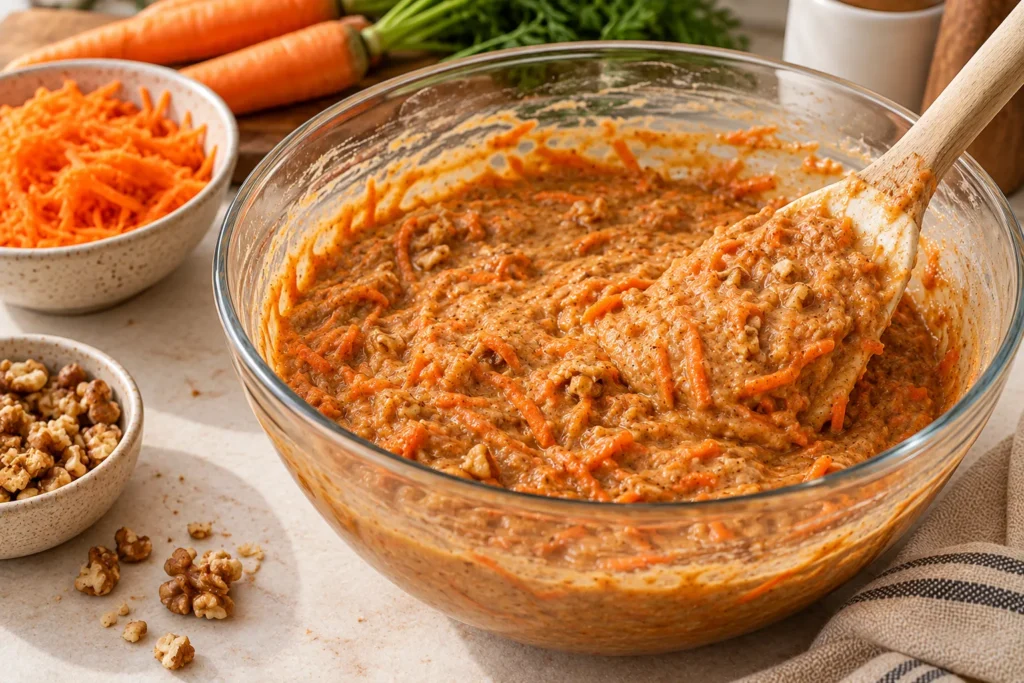
In a large mixing bowl, whisk the eggs, granulated sugar, and brown sugar until the mixture looks smooth and well combined.
Add the vegetable oil and vanilla extract. Whisk again until everything is evenly incorporated.
The mixture should look glossy and slightly thick. There is no need to beat it until it becomes pale and fluffy, as this recipe relies on oil for moisture rather than the creaming method used in butter cakes.
Step 5: Add the Dry Ingredients
Add the flour mixture to the wet ingredients in two or three additions.
Use a rubber spatula or whisk to combine gently until the dry flour is almost fully incorporated. Avoid vigorous mixing or continuing to stir for too long, as overmixing can make the finished cake less tender.
A few small streaks of flour are fine at this stage because you will mix the batter again when adding the carrots.
Step 6: Fold in the Carrots and Optional Add-Ins
Add the grated carrots and gently fold them into the batter until evenly distributed.
If desired, fold in the chopped walnuts, pecans, or raisins. Make sure the additions are spread throughout the mixture rather than concentrated in one area.
The finished batter will be relatively thick but still easy to spread. Do not add extra flour simply because it looks thicker than a typical vanilla cake batter.
Step 7: Divide the Batter Between the Pans
Divide the batter evenly between the two prepared cake pans. Use a spatula to smooth the tops.
For more even layers, weigh the filled pans if you have a kitchen scale.
Tap each pan gently against the counter once or twice to release large air pockets. Avoid excessive tapping, which is unnecessary for this type of cake.
Step 8: Bake Until the Cakes Are Done
Place the pans on the center rack of the preheated oven. Bake for approximately 28–35 minutes, checking toward the beginning of the range because ovens vary.
The cakes are ready when:
- The tops look set and spring back lightly when touched.
- A toothpick inserted into the center comes out clean or with a few moist crumbs.
- The edges begin to pull slightly away from the sides of the pans.
If the toothpick comes out with wet batter, continue baking for a few minutes and check again.
Avoid opening the oven repeatedly during the first 20 minutes, as temperature changes can interfere with even rising.
Step 9: Cool the Cake Layers
Remove the pans from the oven and allow the cakes to cool in their pans for approximately 10–15 minutes.
Run a thin knife around the edges if needed, then carefully turn the cakes out onto a wire rack. Remove the parchment paper and let the layers cool completely.
This step is essential. Warm cake can melt the cream cheese frosting, causing it to become runny and slide off the layers.
For easier frosting, wrap the completely cooled layers and refrigerate them for 30–60 minutes. Slightly chilled cake is often easier to assemble neatly.
How to Make Cream Cheese Frosting
Step 1: Beat the Cream Cheese and Butter
Place the softened cream cheese and butter in a large mixing bowl.
Using an electric mixer on medium speed, beat until smooth and creamy, scraping down the sides of the bowl as needed. The mixture should have no large lumps.
Avoid beating for an excessively long time, especially if the ingredients are very warm, because cream cheese frosting can become loose.
Step 2: Add the Powdered Sugar
Add the sifted powdered sugar in two or three additions, mixing on low speed after each addition to avoid a cloud of sugar.
Once the sugar is incorporated, add the vanilla extract and a small pinch of salt.
Increase the mixer speed briefly and beat just until the frosting is smooth and spreadable.
Step 3: Adjust the Consistency
If the frosting seems too soft, refrigerate it for 15–20 minutes before using it.
If it is too thick, let it stand briefly at room temperature and stir gently. Avoid adding liquid unless absolutely necessary, because even a small amount can make cream cheese frosting less stable.
The ideal consistency should be creamy enough to spread easily but firm enough to hold its shape between the cake layers.
How to Assemble and Frost the Carrot Cake
Step 1: Prepare the First Layer
Place one completely cooled cake layer on a cake stand or serving plate. If the top is noticeably domed, carefully level it with a serrated knife.
Spread a generous, even layer of cream cheese frosting over the top.
Step 2: Add the Second Layer
Carefully place the second cake layer on top, with the flatter side facing upward if possible.
Press gently to help the layers settle into place without squeezing out too much frosting.
Step 3: Apply a Crumb Coat
Spread a thin layer of frosting over the top and sides of the cake. This crumb coat traps loose crumbs and creates a cleaner final finish.
Refrigerate the cake for approximately 15–20 minutes, or until the coating feels slightly firm.
Step 4: Apply the Final Frosting
Spread the remaining frosting over the top and sides of the cake. You can create a smooth finish with an offset spatula or make decorative swirls for a more homemade bakery look.
For a simple decoration, sprinkle chopped walnuts or pecans around the edge. A few thin carrot-shaped decorations made from frosting can also make the cake suitable for Easter celebrations.
For the neatest slices, refrigerate the assembled cake for about 30 minutes before cutting.
Tips for the Best Bakery-Style Carrot Cake
Use freshly grated carrots. They provide better moisture and texture than dry, pre-shredded carrots.
Measure the flour accurately. Too much flour can make the cake dense or dry. If using measuring cups, spoon the flour into the cup and level it rather than packing it down.
Use room-temperature eggs. They incorporate more easily into the wet ingredients and help create a more uniform batter.
Do not overmix. Once the flour is added, mix only until the ingredients are combined.
Check your oven temperature. An oven thermometer can help if your cakes regularly bake too quickly or too slowly.
Let the cake cool completely. Frosting a warm cake is one of the easiest ways to end up with a runny, uneven finish.
Keep the frosting cool. If your kitchen is warm, refrigerate the frosting briefly before assembling the cake.
Allow the flavors to develop. Carrot cake often tastes even better after resting overnight in the refrigerator, once the spices, carrots, and frosting have had time to settle together.
Common Carrot Cake Mistakes and How to Avoid Them
| Mistake | Why It Happens | How to Fix It |
|---|---|---|
| Dry cake | Too much flour or overbaking | Measure flour carefully and check for doneness early |
| Dense texture | Overmixing or inaccurate measurements | Fold gently and measure ingredients precisely |
| Soggy center | Underbaking or unusually wet carrots | Bake until the center is set and a toothpick shows no wet batter |
| Cake sticks to the pan | Insufficient preparation | Grease the pans and line the bottoms with parchment |
| Runny frosting | Warm ingredients or excessive mixing | Keep the cream cheese cool and chill the frosting briefly |
| Cake layers slide | Soft frosting or warm cake | Cool the layers completely and chill before assembling |
| Uneven layers | Batter divided inaccurately | Weigh the batter or use the same measuring cup for both pans |
Easy Variations to Try
Carrot Cake with Walnuts
Fold 3/4 cup of chopped walnuts into the batter. For extra flavor, lightly toast the walnuts and let them cool before adding them. Their earthy flavor and crunchy texture pair beautifully with the soft cake.
Carrot Cake with Pecans
Replace the walnuts with chopped pecans. Pecans have a buttery flavor and are especially delicious with cream cheese frosting.
Carrot Cake with Raisins
Add 1/2 cup of raisins for extra sweetness. If your raisins are particularly dry, soak them briefly in warm water, then drain and pat them dry before folding them into the batter.
Pineapple Carrot Cake
For a tropical variation, add a small amount of well-drained crushed pineapple. Because pineapple introduces extra moisture, avoid adding too much, and expect that the baking time or texture may vary slightly.
Carrot Cake with Orange Zest
Add 1–2 teaspoons of finely grated orange zest to the wet ingredients. The citrus aroma brightens the warm spices and adds a fresh flavor.
Single-Layer Carrot Cake
Prefer a simpler dessert? Bake the batter in a suitable single-layer pan, adjusting the baking time according to the pan’s depth. Check the center carefully and avoid filling the pan more than about two-thirds full.
How to Store Homemade Carrot Cake
Because the cream cheese frosting contains dairy, the finished cake should be refrigerated.
In the refrigerator: Store the cake in an airtight container or under a cake dome for approximately 4–5 days. Let individual slices stand at room temperature for about 15–25 minutes before serving if you prefer a softer texture.
At room temperature: Keep the unfrosted cake covered only for a short period while it cools or is being assembled. Once frosted, do not leave it out for extended periods; refrigerate leftovers promptly. As a general food-safety rule, perishable cream cheese frosting should not remain at room temperature for more than two hours, or one hour in temperatures above 90°F (32°C).
In the freezer: For the best results, freeze unfrosted, completely cooled cake layers individually. Wrap each layer tightly in plastic wrap, then place it in a freezer-safe bag or container. Freeze for up to about 3 months for good quality. Thaw in the refrigerator while still wrapped, then frost when fully thawed.
You can also freeze individual frosted slices in a single layer until firm, then wrap and store them in an airtight container. Allow the slices to thaw in the refrigerator before serving.
Make-Ahead Instructions
This carrot cake is an excellent dessert to prepare ahead of time.
The day before serving: Bake the cake layers, cool them completely, wrap them tightly, and refrigerate. Prepare the frosting separately and keep it covered in the refrigerator.
On serving day: Let the frosting soften slightly if necessary, stir it until smooth, and assemble the cake. Decorate the top just before serving if you want the neatest finish.
You can also assemble the entire cake a day ahead. Keep it refrigerated in a covered container and allow it to rest briefly at room temperature before serving.
What to Serve with Carrot Cake
Carrot cake is rich enough to stand on its own, but a few simple accompaniments can make it feel even more special.
- Coffee: Black coffee or a latte balances the sweetness of the frosting.
- Tea: Earl Grey, English breakfast tea, or chai pairs nicely with the cinnamon and nutmeg.
- Fresh berries: Strawberries or raspberries provide a fresh contrast to the rich cream cheese frosting.
- Vanilla ice cream: A small scoop makes each slice feel like a restaurant-style dessert.
- Toasted nuts: A little extra walnut or pecan crunch adds texture and reinforces the cake’s warm flavor.
Frequently Asked Questions
Can I make carrot cake without nuts?
Yes. The nuts are entirely optional, and the recipe works without them. Simply leave them out or replace them with raisins if you want additional texture and sweetness.
Do I need to peel the carrots?
Peeling is recommended for the smoothest texture and appearance. Wash the carrots thoroughly first, then peel and grate them finely.
Can I use pre-shredded carrots?
Freshly grated carrots are preferable because packaged shredded carrots can be dry and coarse. If pre-shredded carrots are your only option, grate or chop them more finely before adding them to the batter.
Why is my carrot cake dense?
A dense cake can result from too much flour, overmixing, old leavening agents, or underbaking. Measure the ingredients accurately, check that the baking soda and baking powder are fresh, and mix the batter only until combined.
Can I make this recipe in a 9-by-13-inch pan?
Yes, you can bake the batter in a greased and parchment-lined 9-by-13-inch pan. Because the batter will have a different depth, the baking time will change. Begin checking around 30 minutes and continue until the center is set and a toothpick comes out without wet batter.
Can I make carrot cake cupcakes?
Yes. Divide the batter among lined cupcake wells, filling each approximately two-thirds full. Bake at 350°F (175°C), checking around 18–24 minutes. The exact time depends on the size of your cupcake pan and your oven.
Can I make the cake without cream cheese frosting?
Absolutely. A light vanilla buttercream, whipped frosting, or simple powdered-sugar glaze can work. However, cream cheese frosting provides the classic tangy flavor most people associate with traditional carrot cake.
How do I keep cream cheese frosting from becoming runny?
Use full-fat block cream cheese, avoid overbeating, and make sure the cake layers are completely cool. If the frosting softens too much, refrigerate it briefly before spreading.
Does carrot cake need to be refrigerated?
Yes, when topped with cream cheese frosting, it should be refrigerated for food safety. Store it covered and remove only the portions you plan to serve.
Can I make this cake a day ahead?
Yes. In fact, making it ahead can improve convenience and allow the flavors to develop. Keep the finished cake covered in the refrigerator and let slices soften slightly before serving.
Can I reduce the sugar?
You can experiment with reducing the sugar slightly, but sugar affects moisture, tenderness, browning, and structure as well as sweetness. Start with a modest reduction rather than removing a large amount.
Final Thoughts
This bakery-style homemade carrot cake combines a soft, moist crumb, warm spices, freshly grated carrots, and rich cream cheese frosting in one classic dessert. Its straightforward method makes it approachable for home bakers, while the layered presentation gives it a polished finish worthy of a celebration.
Follow the simple steps, measure your ingredients carefully, and allow the cake layers to cool completely before frosting. Add walnuts, pecans, raisins, or orange zest to make the recipe your own.
Serve it for a birthday, holiday gathering, afternoon coffee, or whenever you want a comforting homemade dessert. One slice of this moist, spiced carrot cake is a delicious reminder that bakery-style baking can be achieved right in your own kitchen.
Recipe Card
Recipe: Bakery-Style Homemade Carrot Cake
Preparation time: 25 minutes
Baking time: 28–35 minutes
Cooling and decorating time: Approximately 1 hour
Total time: Approximately 2 hours
Yield: 10–12 servings
Category: Dessert, Cake
Cuisine: American-inspired
Equipment: Two 9-inch cake pans, mixing bowls, whisk, grater, mixer, wire rack
Ingredients
Cake
- 2 cups (250 g) all-purpose flour
- 1 teaspoon baking soda
- 1 teaspoon baking powder
- 1/2 teaspoon salt
- 2 teaspoons cinnamon
- 1/4 teaspoon nutmeg
- 3 large eggs
- 3/4 cup (150 g) granulated sugar
- 3/4 cup (165 g) packed light brown sugar
- 1 cup (240 ml) vegetable oil
- 2 teaspoons vanilla extract
- 3 cups (approximately 300 g) finely grated carrots
- 3/4 cup chopped walnuts or pecans, optional
- 1/2 cup raisins, optional
Cream Cheese Frosting
- 8 oz (225 g) full-fat cream cheese
- 1/2 cup (113 g) unsalted butter
- 3 cups (360 g) powdered sugar
- 1 teaspoon vanilla extract
- Pinch of salt
Instructions
- Preheat the oven to 350°F (175°C). Grease two 9-inch round cake pans and line their bottoms with parchment paper.
- Whisk together the flour, baking soda, baking powder, salt, cinnamon, and nutmeg in a medium bowl.
- In a large bowl, whisk the eggs, granulated sugar, and brown sugar. Add the oil and vanilla and mix until smooth.
- Add the dry ingredients to the wet ingredients and stir gently until almost combined.
- Fold in the grated carrots and, if desired, the nuts and raisins.
- Divide the batter evenly between the prepared pans and smooth the tops.
- Bake for 28–35 minutes, or until a toothpick inserted in the center comes out without wet batter.
- Cool in the pans for 10–15 minutes, then transfer the cakes to a wire rack to cool completely.
- Beat the cream cheese and butter until smooth. Add the powdered sugar gradually, then mix in the vanilla and salt.
- Place one cake layer on a serving plate and spread frosting over the top. Add the second layer, apply a thin crumb coat, and chill briefly.
- Spread the remaining frosting over the top and sides. Decorate with chopped nuts if desired.
- Refrigerate the cake until serving and store leftovers covered in the refrigerator.
Recipe Notes
- Finely grate fresh carrots and do not squeeze out their moisture.
- Use room-temperature eggs for easier mixing.
- Avoid overmixing after adding the flour.
- Cool the cake completely before frosting.
- Refrigerate the finished cake because of the cream cheese frosting.
- Baking times vary by oven, so use the toothpick test to check doneness.
Estimated nutrition per serving: Approximately 550–700 calories, depending on slice size, frosting quantity, and optional additions. This is a rough estimate, not a laboratory-tested nutritional analysis.