
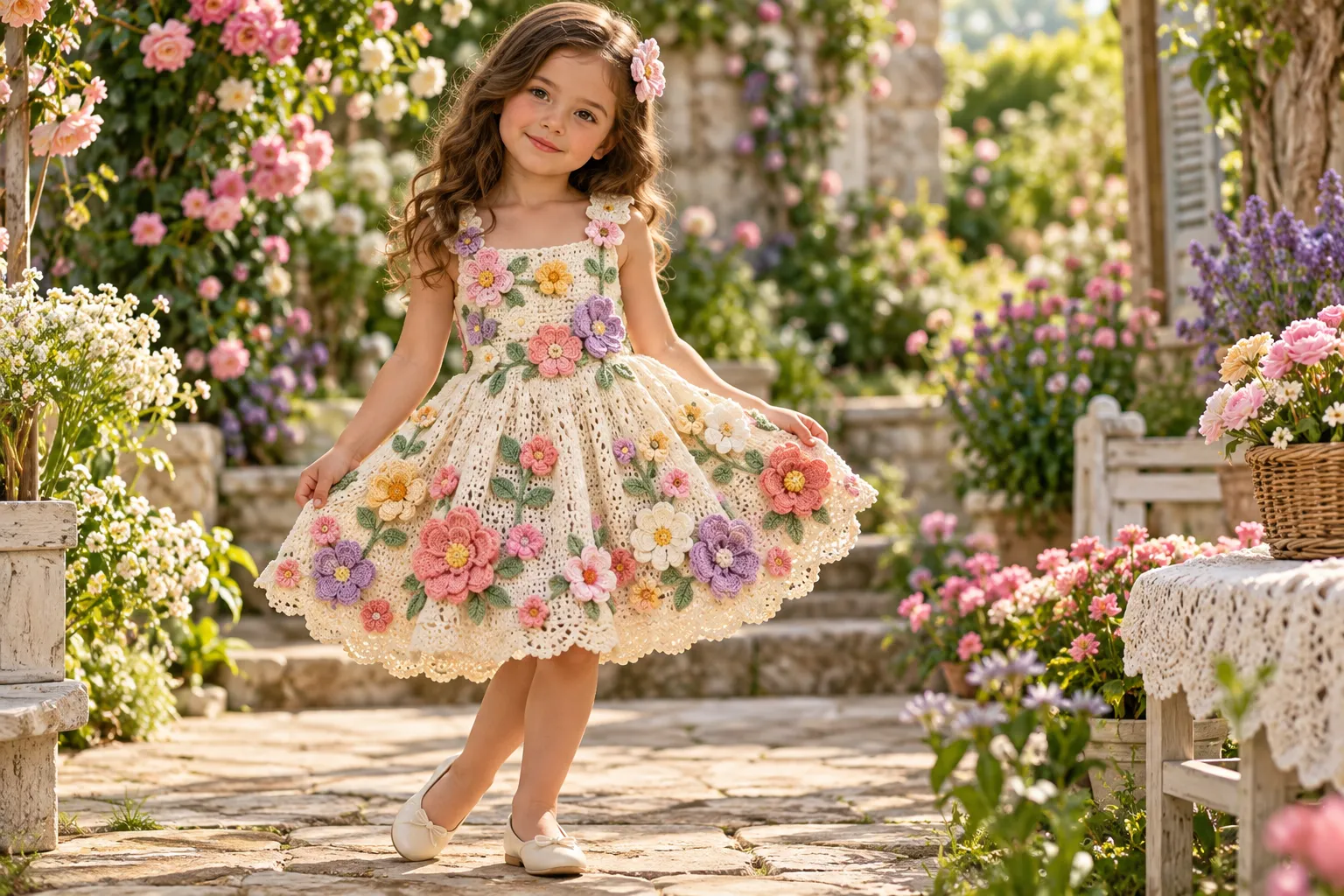
A crochet flower dress is one of those handmade projects that feels like a little piece of art. With colorful crochet flowers, delicate texture, and a playful silhouette, it can turn a simple handmade garment into something truly special.
This crochet flower dress for girls is designed to be both beautiful and practical, with a construction that allows you to customize the colors, length, fit, and floral details. It can be made for everyday wear, birthdays, photo sessions, holidays, or as a thoughtful handmade gift.
In this guide, you’ll find a complete approach to creating a flower-inspired crochet dress, including materials, sizing, construction, flower motifs, step-by-step instructions, finishing techniques, customization ideas, and styling suggestions.
Why Make a Crochet Flower Dress?
A handmade crochet dress offers something that store-bought clothing simply cannot: complete creative freedom.
You can choose exactly:
- The flower colors
- The base color
- The dress length
- The neckline
- The sleeve style
- The waist shape
- The skirt fullness
- The type of yarn
- The decorative border
The floral design also makes the project especially suitable for spring and summer.
A crochet flower dress can be worn for:
- Birthday parties
- Family photos
- Weddings
- Holidays
- Summer outings
- Garden parties
- Special celebrations
- Handmade baby and children’s gifts
Materials You’ll Need
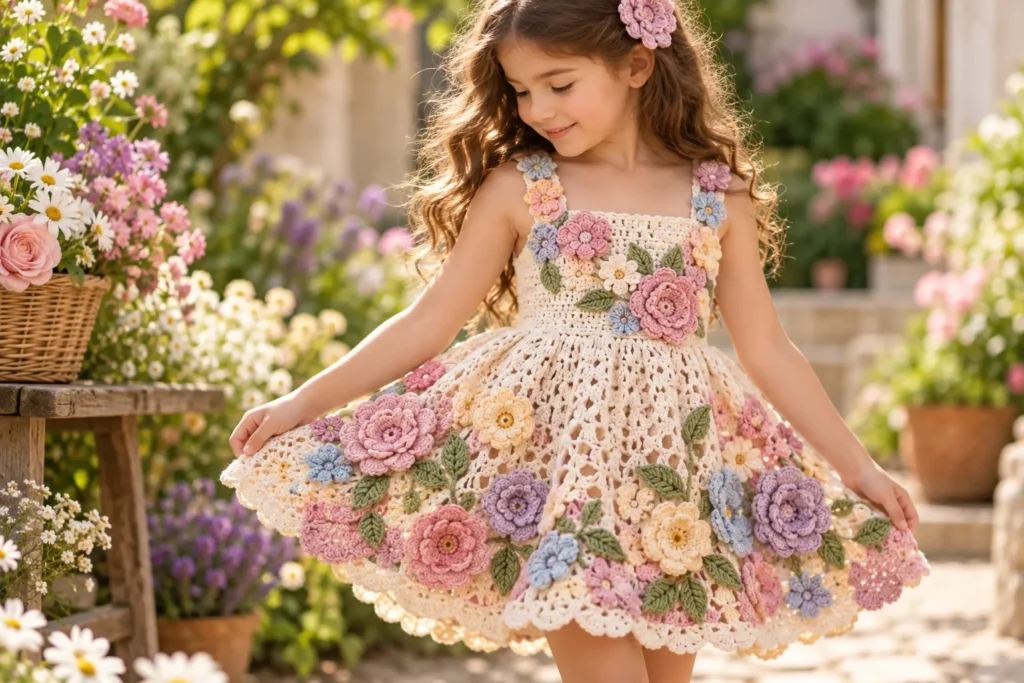
Choose soft yarn that feels comfortable against a child’s skin.
| Material | Suggested Choice |
|---|---|
| Main yarn | Soft cotton or cotton blend |
| Flower yarn | Cotton in coordinating colors |
| Crochet hook | Appropriate to your yarn weight |
| Tapestry needle | For sewing and finishing |
| Scissors | Sharp yarn scissors |
| Stitch markers | Useful for shaping |
| Measuring tape | Essential for sizing |
| Buttons | Optional |
| Blocking mat | Helpful for flower motifs |
Choosing the Right Yarn
Cotton is particularly useful for children’s summer dresses because it is breathable and gives crochet flowers good stitch definition.
A cotton blend can provide a little more softness and drape.
Look for yarn that is:
- Soft
- Washable
- Breathable
- Lightweight
- Comfortable against skin
- Suitable for children’s clothing
Avoid rough or heavily textured yarns that may feel uncomfortable around the neckline or arms.
Choosing Your Colors
The color palette can completely change the personality of the dress.
Soft Pastel Flower Dress
Try:
- Cream
- Blush pink
- Lavender
- Baby blue
- Soft yellow
This creates a delicate, dreamy appearance.
Rainbow Flower Dress
Use several cheerful flower colors against a neutral cream or white base.
This is perfect for a playful summer dress.
Pink and White
A combination of white, pale pink, dusty rose, and soft green creates a classic feminine floral look.
Bright Summer Palette
For a more colorful dress, try:
- Coral
- Turquoise
- Yellow
- Orange
- Pink
- Green
Neutral Flower Dress
For a modern look, use cream or beige as the base and combine it with muted sage, terracotta, caramel, and dusty rose flowers.
Understanding the Construction
Before beginning, it helps to understand how the dress is assembled.
A simple flower dress can be divided into several sections:
- Bodice
- Waist
- Skirt
- Flower motifs
- Shoulder or sleeve details
- Neckline
- Hem
- Finishing
The bodice provides the structure while the skirt gradually increases in width.
Flowers can be crocheted separately and attached afterward or incorporated into the garment as part of the construction.
Crochet Flower Motif
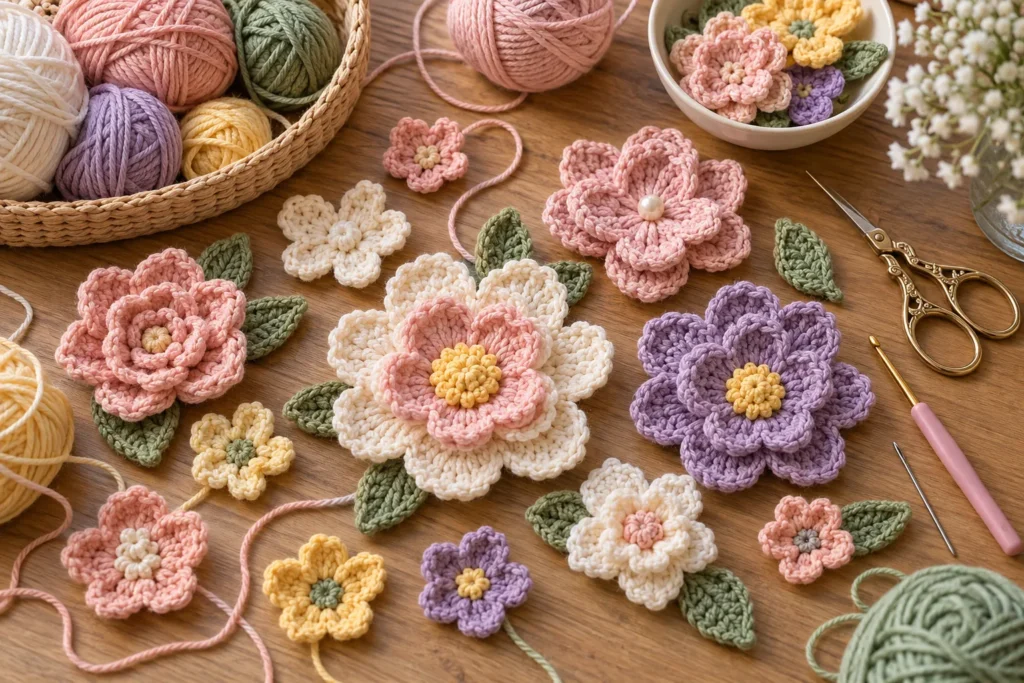
The flowers are the main decorative feature of this project.
A simple crochet flower can be made with a center and several rounded petals.
Basic Flower Structure
You will generally need:
- A center ring
- Stitches forming the flower center
- Chain spaces
- Petal stitches
- A final joining stitch
The exact stitch count can be adjusted depending on the yarn and desired flower size.
Step-by-Step Flower Tutorial
Step 1: Create the Center
Begin with a magic ring or a small chain ring.
Work several stitches into the center to create a compact flower core.
Join the round carefully.
Step 2: Create the Petal Spaces
Work chains around the center to create individual spaces for each petal.
Keep the spacing relatively even so the finished flower remains symmetrical.
Step 3: Crochet the Petals
Work several stitches into each chain space to create rounded petals.
Depending on your desired look, you can use combinations of:
- Single crochet
- Half double crochet
- Double crochet
- Treble crochet
Larger stitches generally create taller and more dramatic petals.
Step 4: Finish the Flower
Join the final petal to the beginning of the round.
Fasten off and weave in the ends.
Gently shape the petals with your fingers.
Making the Dress Bodice
The bodice should fit comfortably without being excessively tight.
Begin by creating the foundation chain according to the child’s chest measurement.
Join carefully if working in rounds.
First Rows
Work your chosen stitch pattern evenly across the foundation.
For a simple bodice, single crochet or half double crochet creates a stable fabric.
Continue until the bodice reaches the desired underarm or waist measurement.
Creating the Waist
The waist is where the bodice transitions into the skirt.
You can create a defined waist by slightly changing the stitch pattern or hook size.
Another option is to crochet a simple decorative waistband.
A contrasting row of stitches can visually separate the bodice from the skirt.
Building the Skirt
The skirt should gradually become wider as you move downward.
To create fullness, introduce increases at regular intervals.
For example, you can increase by working additional stitches into selected sections of the previous round.
Continue increasing until you achieve your preferred skirt width.
A more dramatic increase creates a fuller dress, while fewer increases produce a straighter silhouette.
Adding the Crochet Flowers
Once the main dress structure is complete, arrange the flowers before sewing them permanently.
This is important because it allows you to experiment with placement.
Try arranging flowers:
- Around the waist
- Across the bodice
- Along one shoulder
- Around the hem
- Down one side
- Randomly across the skirt
For a more elegant design, leave plenty of space between individual flowers.
For a playful children’s dress, use clusters of flowers in different sizes.
Creating Flower Clusters
A cluster can include three or five flowers in coordinating colors.
For example:
Cluster 1: Pink + cream + lavender
Cluster 2: Yellow + white + sage
Cluster 3: Coral + peach + cream
Repeat the same combinations throughout the dress to create visual consistency.
Adding Leaves
Small crochet leaves can make the floral decoration look more complete.
Use green yarn in different shades if desired.
Place leaves:
- Beside flower clusters
- Around the waist
- Near the hem
- Between large flowers
- Along a shoulder detail
Avoid covering the entire dress with leaves. A few strategically placed leaves usually create a more elegant result.
Neckline Options
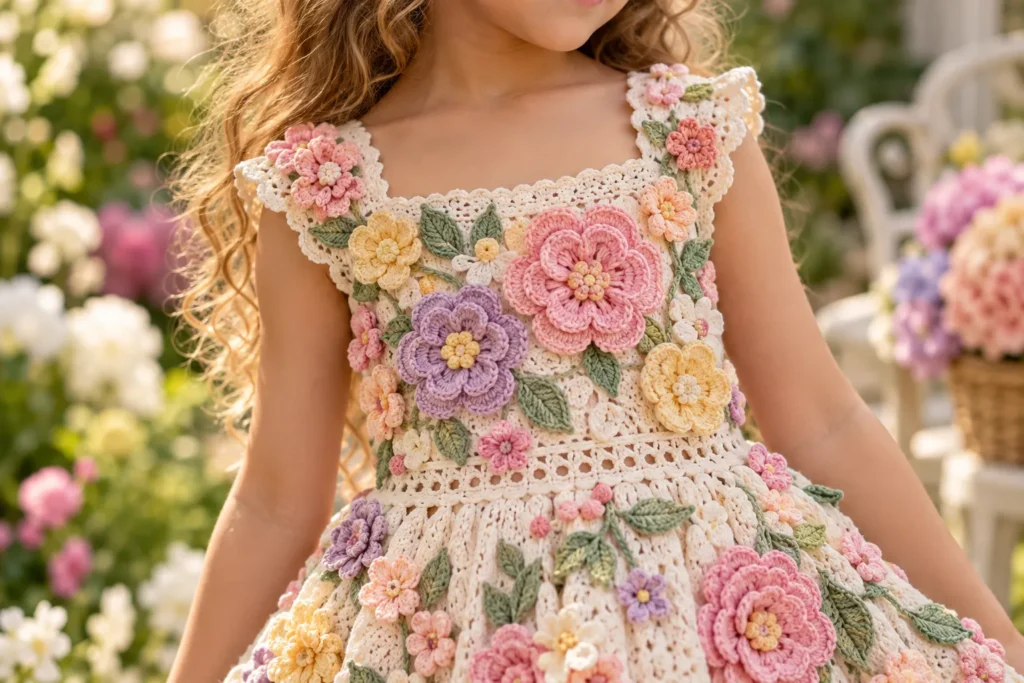
The neckline can dramatically change the final appearance.
Round Neckline
A simple round neckline is comfortable and practical for everyday wear.
Square Neckline
A square neckline creates a more structured and vintage-inspired appearance.
Scalloped Neckline
A scalloped edge complements the flower theme beautifully.
Decorative Flower Neckline
For a special-occasion dress, small flowers can be incorporated around the neckline.
Sleeve Options
You can adapt the dress for different seasons.
Sleeveless
Ideal for summer.
Short Sleeves
A short sleeve provides slightly more coverage while maintaining a lightweight appearance.
Puff Sleeves
Puff sleeves create a charming vintage-inspired children’s dress.
Flutter Sleeves
A lightweight flutter sleeve adds movement and a delicate feminine finish.
Crochet Flower Dress Sizing
Children grow quickly, so accurate measurements are more useful than relying only on age.
| Approximate Age | Chest | Suggested Length |
|---|---|---|
| 1–2 years | Measure child | Adjust to preference |
| 2–3 years | Measure child | Adjust to preference |
| 4–5 years | Measure child | Adjust to preference |
| 6–7 years | Measure child | Adjust to preference |
| 8–9 years | Measure child | Adjust to preference |
| 10–12 years | Measure child | Adjust to preference |
These should be treated as planning categories rather than exact measurements because children’s proportions vary considerably.
How to Measure the Child
Before crocheting the dress, take the following measurements.
Chest
Measure around the fullest part of the chest.
Waist
Measure around the natural waist.
Shoulder Width
Measure from one shoulder to the other.
Dress Length
Measure from the shoulder down to where you want the hem to finish.
Armhole
Measure around the armhole area to ensure comfortable movement.
Add appropriate ease rather than making the garment fit tightly.
How to Adjust the Dress Size
One of the biggest advantages of crochet is how easily you can customize dimensions.
To Make It Wider
Increase the number of foundation stitches or add additional increases to the skirt.
To Make It Longer
Continue crocheting additional skirt rounds.
To Make It Shorter
Stop the skirt earlier and finish with the desired border.
To Make the Bodice Larger
Increase the foundation chain and adjust the number of rows.
Always make a small gauge swatch before committing to the full garment.
Gauge Matters
Gauge determines the size and drape of your finished dress.
Create a small swatch using the yarn and hook you plan to use.
Measure:
- Stitches across
- Rows vertically
If your fabric is too tight, try a larger hook.
If your fabric is too loose, try a smaller hook.
For children’s garments, you generally want a fabric that is flexible but not so loose that it loses its shape.
Creating a Beautiful Crochet Hem
The hem is the perfect place to add another decorative element.
Try:
- Scallops
- Picots
- Shell stitches
- Simple flower motifs
- Contrasting color
- A delicate lace border
A scalloped hem is especially attractive with a floral dress because it echoes the rounded shapes of the petals.
Adding a Waist Tie
A crochet waist tie can provide both decoration and adjustability.
Crochet a long chain and add a simple border if desired.
Thread it through a row around the waist.
For young children, make sure the tie is appropriately secured and doesn’t create a safety hazard.
Flower Placement Ideas
There are many ways to arrange the flowers.
Floral Bodice
Place flowers primarily around the chest and shoulders while keeping the skirt relatively simple.
Floral Hem
Decorate the lower edge of the skirt with evenly spaced flowers.
Side Cascade
Arrange flowers diagonally from one shoulder toward the opposite side of the skirt.
Waist Garland
Create a floral band around the waist.
Scattered Flowers
Place flowers randomly across the dress for a whimsical garden-inspired look.
Styling the Crochet Flower Dress
A handmade flower dress can be styled in several ways.
Summer Look
Pair it with:
- Sandals
- Simple hair accessories
- A lightweight cardigan
- A small woven bag
Birthday Outfit
Add:
- Ballet flats
- A floral hair clip
- A small cardigan
- Delicate accessories
Garden Party
Pair the dress with soft sandals, a sun hat, and a lightweight cardigan.
Cooler Weather
Layer it over a long-sleeve top and add tights, ankle boots, and a knitted cardigan.
Matching Crochet Accessories
You can create a complete handmade outfit by adding matching accessories.
Consider making:
- Crochet headband
- Flower hair clips
- Baby sandals
- Small handbag
- Matching cardigan
- Crochet bracelet
- Flower bonnet
Using the same yarn colors across the accessories makes the outfit feel coordinated.
Photographing the Finished Dress
If you’ve spent hours making a crochet dress, good photography can show off the details.
Use soft natural light and photograph the dress near a large window.
Capture:
- Full dress
- Bodice details
- Flower close-ups
- Hem
- Back
- Side profile
- Stitch texture
A neutral background will help colorful flowers stand out.
Tips for a Professional Finish
Small finishing details can make a handmade garment look significantly more polished.
Weave in Ends Carefully
Secure all yarn tails and weave them through several stitches before trimming.
Block the Flowers
Light blocking can help individual petals sit neatly.
Check the Seams
Make sure joining points are secure and comfortable.
Keep the Edges Even
Consistent edging creates a professional-looking silhouette.
Wash Before Wearing
If appropriate for your yarn, gently wash and dry the finished garment according to the yarn manufacturer’s instructions.
Common Mistakes to Avoid
Skipping the Gauge Swatch
A beautiful pattern can still end up the wrong size if your tension differs significantly.
Using Scratchy Yarn
Children’s garments should feel soft against the skin.
Making the Bodice Too Tight
Allow enough ease for movement and layering.
Adding Too Many Flowers
Too many motifs can make the dress visually heavy.
Ignoring Weight
A very large number of decorative motifs can make a dress heavier and affect the drape.
Crochet Flower Dress Color Ideas
| Style | Main Color | Flower Colors |
|---|---|---|
| Romantic | Cream | Pink, lavender, sage |
| Rainbow | White | Pink, yellow, blue, green |
| Garden | Sage | Cream, peach, pink |
| Sunset | Cream | Coral, orange, yellow |
| Vintage | Ivory | Dusty rose, mustard, brown |
| Modern | Beige | Rust, sage, cream |
| Princess | Blush | White, lavender, pale pink |
Frequently Asked Questions
Is a crochet flower dress suitable for beginners?
The individual components can be beginner-friendly, but assembling and sizing a complete garment requires more attention. If you’re new to crochet clothing, practice the flower motif and make a gauge swatch first.
What yarn is best for a crochet flower dress?
Soft cotton or cotton-blend yarn is an excellent choice for lightweight children’s dresses, particularly for warm weather.
Can I make the dress without flowers?
Yes. You can use the same basic construction and replace the flower decoration with stripes, textured stitches, granny squares, or a simple solid-color design.
How can I make the skirt fuller?
Add increases at regular intervals as you work downward. More frequent increases will generally produce a fuller skirt.
Can I make matching flowers for the hair?
Absolutely. Crochet several small flowers and attach them to hair clips or a headband for a coordinated outfit.
Can I make this dress for an older child?
Yes. Take the child’s actual measurements and adjust the bodice, waist, skirt width, and length accordingly.
Final Thoughts
A crochet flower dress for girls is more than just a clothing project. It’s an opportunity to combine color, texture, creativity, and traditional crochet techniques into something genuinely personal.
The basic dress can remain simple while the flowers provide most of the visual character. By changing the yarn colors, flower sizes, placement, neckline, sleeves, and hem, you can create completely different versions from the same concept.
Whether you’re making a delicate pastel dress for a little girl’s birthday, a colorful summer outfit, or a special handmade gift, this flower-inspired crochet design offers plenty of room for creativity.