
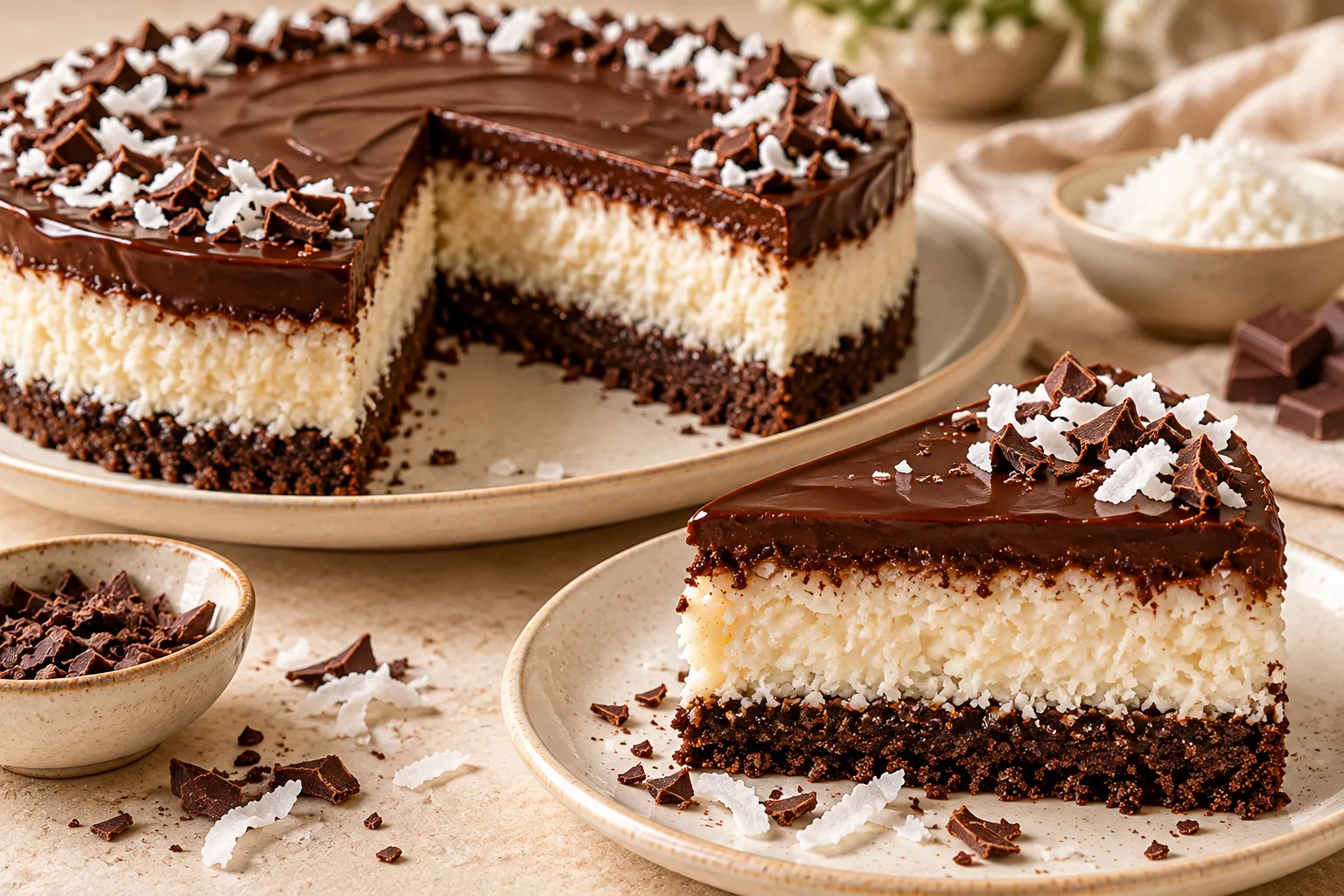
If you’re craving a rich chocolate dessert with a creamy coconut center, this Decadent No-Bake Chocolate Coconut Cake is the perfect recipe to try. Made with a buttery chocolate biscuit base, a sweet coconut filling, and a smooth chocolate ganache topping, this irresistible dessert delivers three delicious layers in every bite.
The best part? You don’t need an oven. This easy refrigerator cake uses simple ingredients and requires very little hands-on preparation. Once assembled, it chills in the refrigerator until the layers become firm and easy to slice.
Whether you’re preparing a dessert for a birthday, holiday gathering, family dinner, or weekend treat, this chocolate coconut cake is an elegant option that looks impressive without complicated baking techniques.
Why You’ll Love This No-Bake Chocolate Coconut Cake
- No oven needed: Assemble the layers and let the refrigerator do the work.
- Three irresistible layers: Enjoy a chocolate biscuit crust, creamy coconut filling, and rich chocolate topping.
- Simple ingredients: The recipe uses everyday ingredients that are easy to find.
- Perfect for making ahead: Prepare the cake the day before serving.
- Beautiful presentation: The contrast between the white coconut center and dark chocolate topping creates stunning slices.
- Easy to customize: Add toasted coconut, chopped almonds, hazelnuts, or a pinch of sea salt.
- Great for sharing: One cake provides approximately 10–12 servings.
Recipe Overview
Preparation
25 minutes
Chilling
4–6 hours
Total time
4 hr 25 min–6 hr 25 min
Yield
10–12 slices
Difficulty: Easy · Method: No-bake
Ingredients
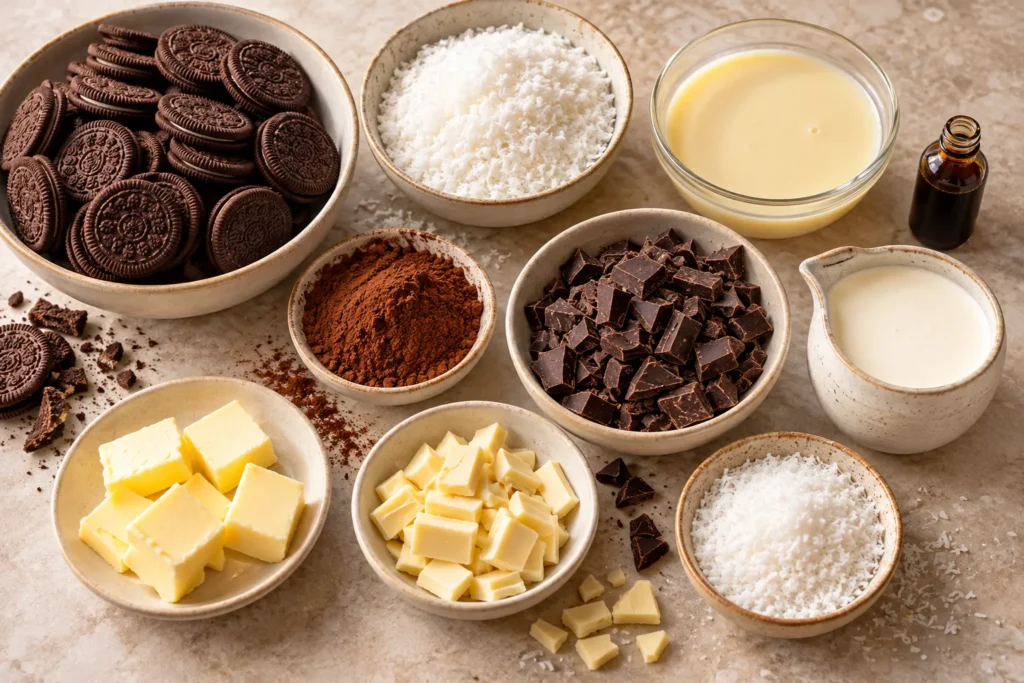
This recipe has three components: the chocolate biscuit base, the creamy coconut filling, and the chocolate ganache topping.
For the Chocolate Biscuit Base
| Ingredient | Quantity |
|---|---|
| Chocolate biscuits or digestive biscuits | 250 g |
| Unsalted butter, melted | 100 g |
| Unsweetened cocoa powder | 2 tablespoons |
| Milk | 3–4 tablespoons |
| Granulated sugar, optional | 1 tablespoon |
Use chocolate biscuits for a deeper chocolate flavor or plain digestive biscuits for a buttery base. If your biscuits are already sweet, you can omit the additional sugar.
For the Creamy Coconut Filling
| Ingredient | Quantity |
|---|---|
| Unsweetened desiccated coconut | 200 g |
| Sweetened condensed milk | 200 g |
| Unsalted butter, softened | 40 g |
| Vanilla extract | 1 teaspoon |
| Heavy cream, optional | 2–3 tablespoons |
The condensed milk binds the coconut together and gives the filling its sweet, creamy texture. The optional heavy cream can help soften the mixture if it feels too dry.
Unsweetened coconut is recommended because the condensed milk already adds considerable sweetness.
For the Chocolate Ganache Topping
| Ingredient | Quantity |
|---|---|
| Dark or semisweet chocolate, chopped | 180 g |
| Heavy cream | 150 ml |
| Unsalted butter, optional | 10 g |
| Fine sea salt, optional | A small pinch |
Dark chocolate balances the sweet coconut filling. Chocolate containing approximately 50–60% cocoa provides a rich flavor without making the topping too bitter.
For a sweeter result, use semisweet chocolate. For a more intense chocolate flavor, choose a darker variety.
Equipment You’ll Need
- One 20 cm (8-inch) round springform cake pan
- Parchment paper
- Mixing bowls
- Food processor or rolling pin
- Small saucepan
- Spatula or spoon
- Offset spatula, optional
- Sharp knife for slicing
A springform pan makes removing the chilled cake much easier. If you use a regular pan, line the bottom and sides with parchment paper, leaving enough overhang to lift the cake out.
How to Make Decadent No-Bake Chocolate Coconut Cake
Step 1: Prepare the Cake Pan
Line the bottom of a 20 cm (8-inch) round cake pan with parchment paper.
If using a springform pan, lightly grease the sides or line them with parchment paper. This helps the finished cake release cleanly and keeps the layers intact.
Place the pan on a flat tray so you can transfer it easily to the refrigerator.
Step 2: Crush the Biscuits
Place the biscuits in a food processor and pulse until they become fine crumbs.
If you don’t have a food processor, put the biscuits in a sturdy sealed bag and crush them with a rolling pin.
Aim for a texture similar to coarse sand. Large pieces can make the base uneven and difficult to slice.
Transfer the crumbs to a mixing bowl and stir in the cocoa powder and optional sugar.
Step 3: Prepare the Chocolate Biscuit Base
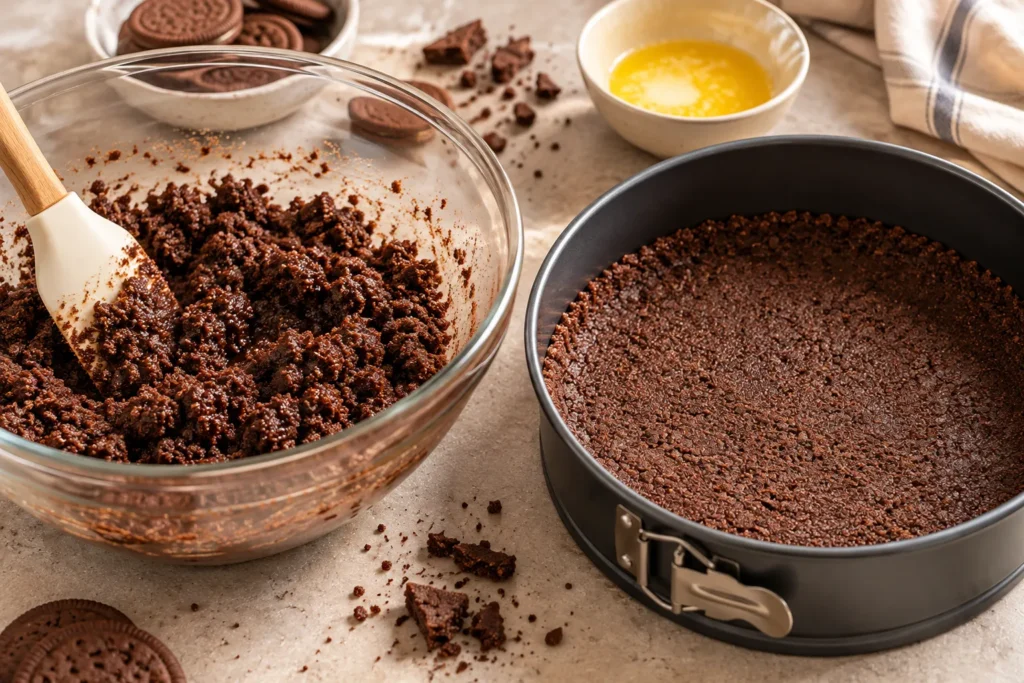
Pour the melted butter into the biscuit crumbs and mix thoroughly.
Add the milk one tablespoon at a time, stirring after each addition. The mixture should resemble damp sand and hold together when pressed between your fingers.
You may need only three tablespoons of milk, depending on the biscuits you use. Add the fourth tablespoon only if necessary.
Transfer the mixture to the prepared pan and press it firmly into an even layer.
Use the flat bottom of a glass or measuring cup to compact the crumbs, paying particular attention to the edges.
Refrigerate the base for 20–30 minutes while preparing the coconut filling.
Step 4: Make the Creamy Coconut Filling
In a large bowl, combine the desiccated coconut, condensed milk, softened butter, and vanilla extract.
Mix until the coconut is evenly coated and the ingredients form a thick, cohesive mixture.
The filling should be moist enough to hold together when pressed but not so wet that it becomes runny.
If it feels too dry, add heavy cream one tablespoon at a time. If it seems too soft, add a little more shredded coconut.
Taste the mixture before assembling the cake. If you prefer a less sweet dessert, stick with unsweetened coconut and avoid adding extra sugar.
Step 5: Add the Coconut Layer
Remove the chilled biscuit base from the refrigerator.
Spoon the coconut mixture over the base and spread it evenly with a spatula.
Press the filling gently into place to remove large air pockets. Make sure the coconut layer reaches the edges of the pan for a clean appearance when sliced.
Smooth the top before adding the chocolate ganache.
Return the pan to the refrigerator for 20–30 minutes to help the coconut layer become more stable.
Step 6: Prepare the Chocolate Ganache
Place the chopped chocolate in a heatproof bowl.
Heat the heavy cream in a small saucepan until it begins to steam. Remove it from the heat before it reaches a vigorous boil.
Pour the hot cream over the chocolate and let it stand for 2–3 minutes.
Stir gently from the center outward until the chocolate melts and the mixture becomes smooth and glossy.
If a few pieces remain unmelted, place the bowl over a pan of gently simmering water and stir carefully until smooth. Keep water out of the chocolate.
Add the optional butter and a small pinch of salt, then stir until fully incorporated.
Let the ganache cool for several minutes until it is still pourable but no longer very hot. This helps prevent the coconut filling from softening excessively.
Step 7: Add the Chocolate Topping
Remove the cake from the refrigerator.
Pour the cooled ganache over the coconut layer, starting in the center and allowing it to spread toward the edges.
Use an offset spatula or the back of a spoon to smooth the surface.
For an elegant finish, keep the chocolate layer level and avoid stirring it into the coconut filling.
You can leave the topping plain or decorate it with toasted coconut flakes, finely chopped almonds, or a few chocolate shavings.
Step 8: Chill Until Firm
Cover the pan loosely and refrigerate the cake for at least 4–6 hours, preferably overnight.
This chilling period allows the biscuit base to firm up, the coconut filling to stabilize, and the chocolate ganache to set.
For the cleanest slices, make sure the center of the cake is fully chilled before removing it from the pan.
Step 9: Remove and Slice
Carefully release the sides of the springform pan. If needed, run a thin knife around the edge before removing the ring.
Transfer the cake to a serving plate.
For neat slices, dip a sharp knife in hot water, wipe it dry, and cut straight down through the layers. Clean and warm the knife between cuts.
Serve chilled for a firm texture or allow each slice to stand briefly at room temperature for a softer, creamier bite.
Tips for the Best Chocolate Coconut Cake
Use finely crushed biscuits. Fine crumbs create a compact base that holds together more easily when sliced.
Add milk gradually. Too much milk can make the biscuit layer soft and difficult to cut.
Adjust the coconut filling carefully. The mixture should be moist and cohesive, not dry or runny.
Let the ganache cool slightly. Pouring very hot ganache onto the filling can soften the coconut layer and cause the layers to blend together.
Chill the cake overnight. Although four to six hours may be enough, overnight chilling often produces the firmest layers.
Use a warm knife. A clean, warm knife helps cut through the chocolate topping without dragging it across the cake.
Balance the sweetness. Dark chocolate and unsweetened coconut help prevent the dessert from becoming excessively sweet.
Delicious Variations to Try
Chocolate Coconut Almond Cake
Add 40–50 g of finely chopped almonds to the coconut filling or sprinkle toasted almond slices over the chocolate topping.
The almonds provide a pleasant crunch and complement the chocolate and coconut flavors.
Dark Chocolate Coconut Cake
Use dark chocolate containing approximately 65–70% cocoa for the ganache.
This creates a more intense chocolate flavor that balances the sweetness of the condensed milk filling.
Bounty-Inspired No-Bake Cake
For a cake inspired by chocolate-covered coconut candy, use a generous coconut layer and a rich chocolate topping.
You can also add a small amount of melted dark chocolate to the biscuit base for a deeper chocolate flavor.
Chocolate Coconut Hazelnut Cake
Mix finely chopped toasted hazelnuts into the biscuit base or sprinkle them over the ganache.
Hazelnuts add a nutty flavor and extra texture that work beautifully with the chocolate and coconut.
Salted Chocolate Coconut Cake
Sprinkle a small amount of flaky sea salt over the ganache just before it sets.
The salt enhances the chocolate flavor and contrasts with the sweet coconut filling. Use it sparingly.
Mini No-Bake Chocolate Coconut Cakes
Divide the biscuit base, coconut filling, and ganache among individual dessert rings or serving glasses.
Chill until firm and serve as individual portions. These mini desserts are especially convenient for parties and dinner gatherings.
How to Store No-Bake Chocolate Coconut Cake
Because the filling contains condensed milk and may include cream, this cake should be refrigerated.
- Refrigerator: Store covered in an airtight container for approximately 4–5 days at 4°C (40°F) or below.
- Freezer: Freeze the whole cake or individual slices, well wrapped, for up to 2 months for best quality.
- Thawing: Transfer frozen portions to the refrigerator and let them thaw gradually.
- Serving: Keep the cake refrigerated until shortly before serving. Avoid leaving it at room temperature for more than 2 hours, or more than 1 hour when temperatures exceed 32°C (90°F).
For the best texture, store the cake in a covered container to prevent it from absorbing odors from other foods.
If freezing individual slices, separate them with parchment paper so you can remove them easily.
Make-Ahead Instructions
This cake is ideal when you need to prepare dessert in advance.
The day before serving: Prepare the biscuit base, coconut filling, and chocolate topping. Refrigerate the assembled cake overnight.
On the day of serving: Remove the cake from its pan, add any final decorations, and slice with a warm knife.
For a party: Keep the cake refrigerated until dessert is served. If transporting it, use an insulated cooler with ice packs.
Preparing the cake ahead of time gives the layers enough time to set and makes serving much easier.
What to Serve with Chocolate Coconut Cake
Although this cake is delicious on its own, simple accompaniments can make it even more special.
- Fresh strawberries or raspberries: Their tartness balances the rich chocolate.
- Coffee or espresso: The bitterness of coffee complements the sweet coconut filling.
- Black tea: A lovely option for an afternoon dessert.
- Vanilla ice cream: Adds a cool, creamy contrast.
- Fresh berries and mint: Create a colorful, elegant presentation.
- Toasted coconut flakes: Add extra coconut aroma and a pleasant crunch.
Keep the accompaniments simple so the chocolate and coconut remain the main attraction.
Common Mistakes to Avoid
| Mistake | How to Avoid It |
|---|---|
| The biscuit base crumbles | Crush the biscuits finely and press the mixture firmly into the pan. |
| The base becomes too soft | Add milk gradually and stop once the crumbs hold together. |
| The coconut filling is dry | Add heavy cream a tablespoon at a time until cohesive. |
| The coconut filling is too soft | Add a little more shredded coconut and chill before topping. |
| The ganache becomes grainy | Avoid overheating the chocolate and stir gently. |
| The layers blend together | Chill the coconut layer and let the ganache cool before pouring. |
| The cake falls apart when sliced | Refrigerate long enough and use a warm, clean knife. |
| The topping cracks | Avoid rapid temperature changes and slice with a warm knife. |
Frequently Asked Questions
Can I make chocolate coconut cake without baking?
Yes. This recipe uses crushed biscuits for the base, a coconut-condensed milk filling, and a chocolate ganache topping. The refrigerator helps the layers become firm, so no oven is required.
Can I use milk chocolate instead of dark chocolate?
Yes. Milk chocolate creates a sweeter topping. Since the coconut filling is already sweet, semisweet or dark chocolate usually provides a better balance.
Can I use fresh coconut?
Fresh coconut may work, but it contains more moisture than desiccated coconut and can change the consistency of the filling. Desiccated coconut is more predictable for this recipe.
Why is my coconut filling too soft?
The mixture may contain too much condensed milk or cream, or the cake may not have chilled long enough. Add a little extra shredded coconut if needed, then refrigerate until firm.
How long does the cake need to chill?
Allow at least four to six hours. Overnight chilling is preferable for the firmest texture and cleanest slices.
Can I make this cake ahead of time?
Absolutely. Prepare it the day before serving and leave it covered in the refrigerator overnight. Add delicate decorations shortly before serving.
Can I make this recipe gluten-free?
Yes. Replace the regular biscuits with gluten-free chocolate or digestive biscuits. Check all product labels if you need to avoid gluten strictly.
Can I make this cake dairy-free?
You can experiment with dairy-free biscuits, plant-based butter, dairy-free condensed coconut milk, and dairy-free chocolate with a suitable plant-based cream. The texture may differ, so adjust the proportions if necessary.
Can I freeze no-bake chocolate coconut cake?
Yes. Wrap the cake or individual slices tightly and freeze for up to two months for best quality. Thaw in the refrigerator before serving.
How can I make the cake less sweet?
Use unsweetened coconut, choose dark chocolate with a higher cocoa percentage, and omit the optional sugar in the biscuit base. A small pinch of salt can also help balance the flavors.
Final Thoughts
This Decadent No-Bake Chocolate Coconut Cake is a wonderful dessert for anyone who loves the combination of chocolate and coconut. Its buttery biscuit base, creamy coconut center, and smooth chocolate topping create a satisfying contrast of flavors and textures without the need for baking.
The recipe is simple enough for beginners yet elegant enough for birthdays, family gatherings, holidays, and special occasions. Prepare it the day before serving, customize it with nuts or toasted coconut, and slice it into beautiful layers when it’s time for dessert.
For the best results, use good-quality chocolate, adjust the coconut filling until it holds together, and give the cake plenty of time to chill.